For practice, every post in my blog will be written in English. Notification for awkward sentences is always be welcomed.
Recently, I joined a project named ‘Near-eye light field device technology development for hyper-realistic metaverse service’. ETRI is the research managing department and we, Inha University is one of two committed research institutions. So, I’ve been studying some light field NED these days and I want to share one of them.
Various technique such as integral imaging, super multiview, and temporal light field can be used for making light field NED.
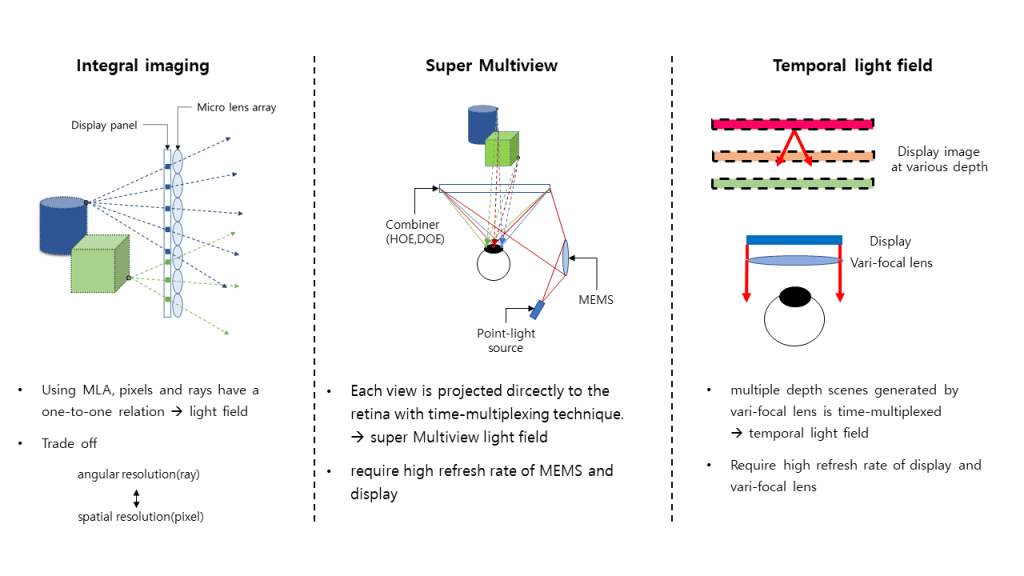
Among them, Oculus half dome 3 adopts the temporal light field technique. The temporal light field generates 3D scene using vari-focal lens or membrane mirror. By changing the optical power of these components 2d scene with multiple depths is created and it becomes a perceptual 3D scene with a fast time-multiplexing technique. more details can be found in ‘B.C. Kress, Optical Architectures for Augmented-, Virtual-, and Mixed-Reality Headsets’
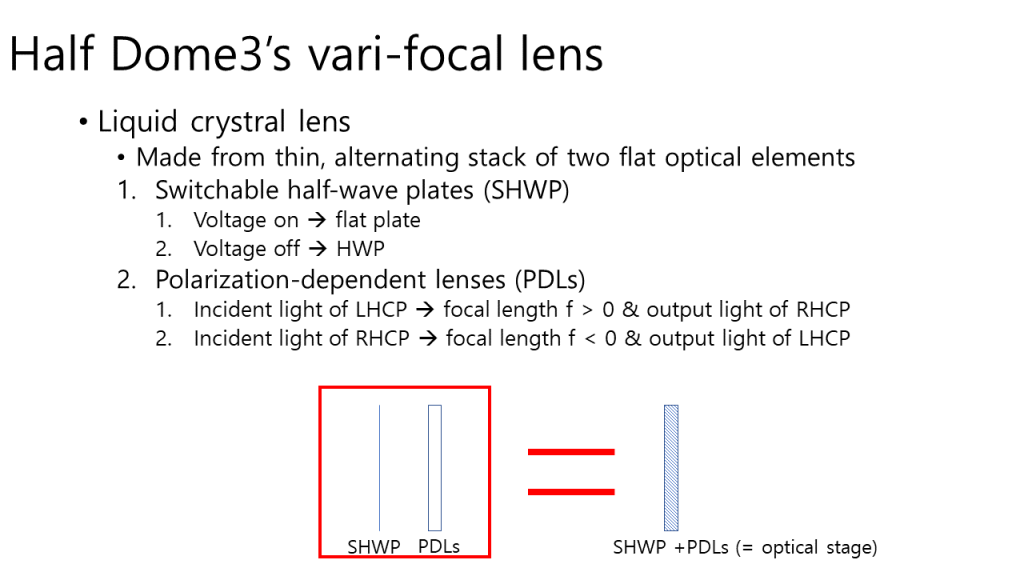
The vari-focal lens used in half dome 3 is stack of optical stage composed of two flat optical components which is switchable half wave plate(SHWP) and polarization-dependent lenses(PDLs). My own summary of this component’s principle is below.
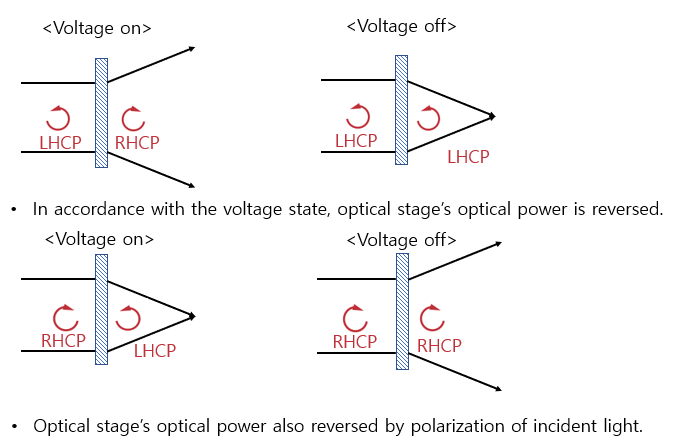
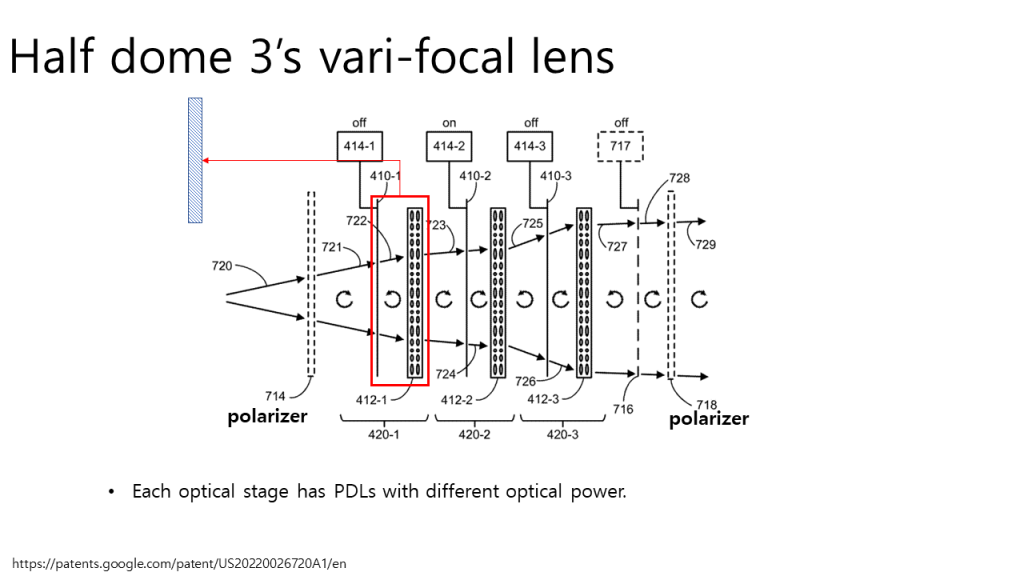
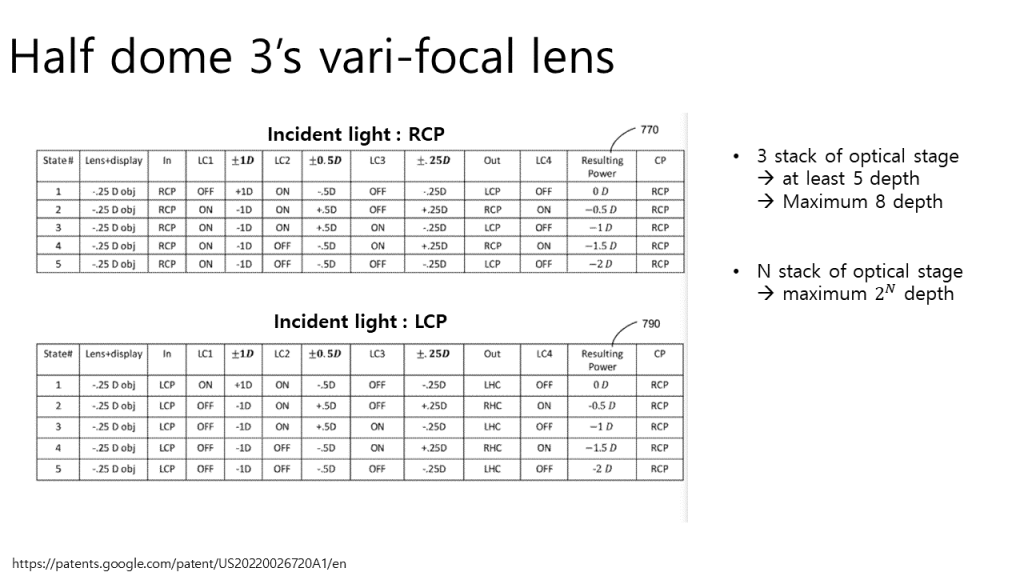
With enough refresh rate of the display, this stacked liquid crystal lenses based vari-focal lens may generate a volumetric scene.
for more details,

 AR/VR Study Bank_W.Han