I’d like to share my study about the principle of pinlight NEDs.
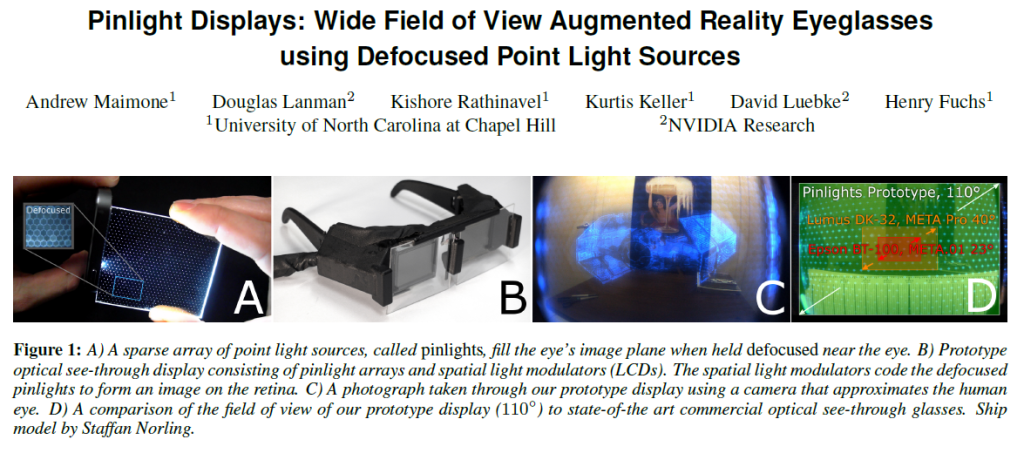
let’s start with the definition. pinlight display is AR NEDs that offer wide FoV and support compact form factor using point light source array and LCD panel.
The core principle is directly encoding the light from a defocused point source placed near the eye. The basic configuration is below figure.

point light source array as a backlight and LCD panel as an image modulation device is located in front of the eye very closely. generally, if some objects are outside of the accommodation range ( very short distance between the eye and objects), it is impossible to see focused objects due to the lack of the eye lens’s optical power. But in this case, light is projected to the retina directly through the above configuration which offers an always focused scene to the user.
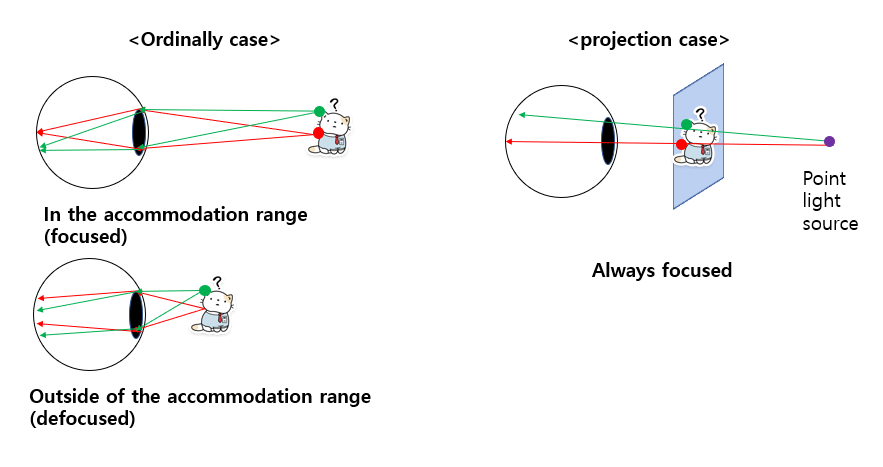
projection case, however, offers very little FoV with a single projector. Therefore in this paper, they implemented multiple point-light source arrays to widen the FoV. By tiling the point light source array and synchronizing each source to the LCD module area, wide FoV is generated. For the tiling, two primary conditions must be satisfied. first, the eye focus plane must contain a continuous tiled image among all the projectors, and the modulated area of the LCD panel must be disjoint among the projectors. This condition limits the design-wise choices.
single pinlight projector generates circular image. It means there will be some overlapped images in eye focus region. In this paper, author makes virtual aperture in modulation plane(LCD) to minimize the gap and creates evenly-toned image. Rectangle or hexagon shape is recommended and they build the prototype using hexagon shape aperture.
 AR/VR Study Bank_W.Han