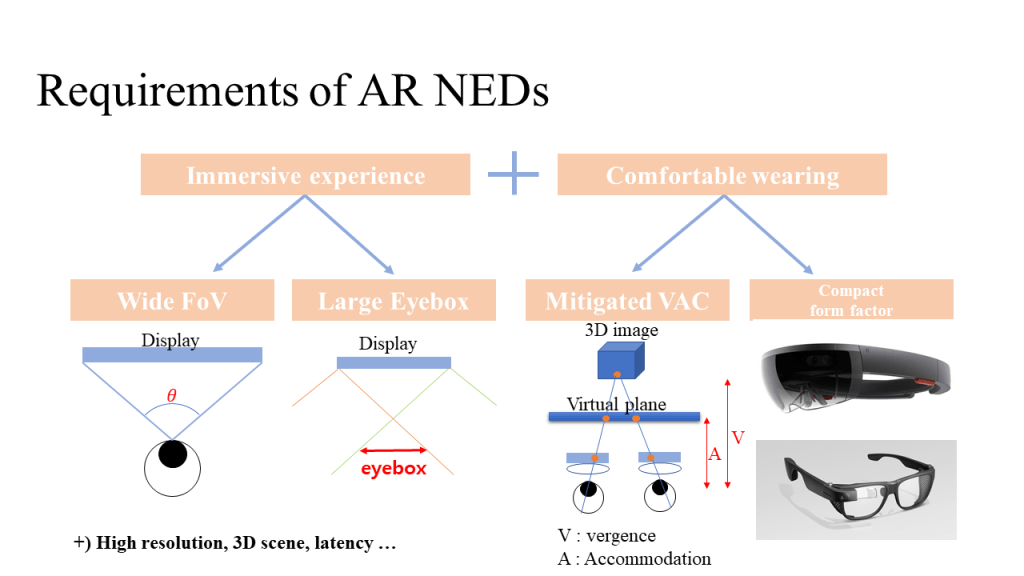
This post is about my understanding of waveguide type near-eye display(NED) optics. let’s start with AR NED’s requirements in the above figure. NED is one of the promising devices for virtual reality(VR), augmented reality(AR), mixed reality(MR), and the metaverse. But products on markets have a small Eyebox and Field of view(FoV), a large form factor, and vergence accommodation conflict which gives users eye fatigue. (FoV is the extent of the observable scene by display and eyebox is the region where all FoV of a display can be observed.) These things do hinder the immersive experience and comfortable wearing of the near-eye display. Among them, the compactness of the NED is the most important part due to the fact that NED is the device users should wear in their heads. On that point, waveguide type NED is a truly promising configuration. To provide wide FoV and large eyebox to users, many suggested methods have to increase their size. However, waveguide type configurations don’t need to. So forerunners in this field like Microsoft and Magicleap use this method.
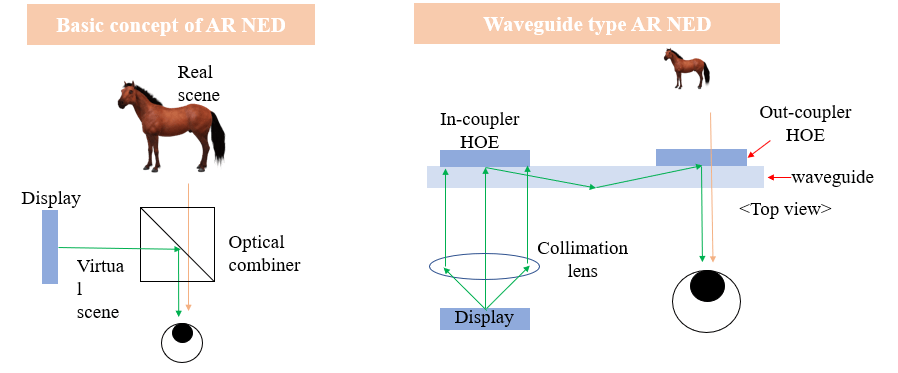
The above figure describes the basic concept of an AR NED and waveguide type NED. AR NED, unlike VR NED, should give both real and virtual scenes to the users. To provide the real scenes, two types are generally used. one is video see-through(VST) and another is optical see-through(OST). the figure is about the OST AR NED which is comprised of an optical combiner and display. As a combiner, we can separate a type into two things, reflective-optics-based and diffractive-optics-based. Examples of reflective-optics-based combiners are Flat beam splitter(B/S), Curved B/S, Birdbath structure, pin-mirror, and partial mirror. Diffractive-optics based include Holographic optical elements(HOE), Diffractive optical elements(DOE) and polarization volume grating(PVG). Generally speaking, light efficiency and image quality are way better when using reflective-optics based, but diffractive optics based is much good at form factor. So many researchers in this field, trying to enhance the image quality, FoV, and eyebox using diffractive-optics-based combiners. In waveguide type NED, diffractive-optics-based combiner is used as indicated in the above figure.
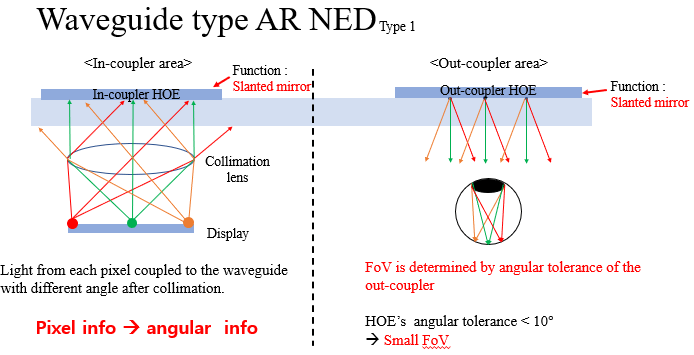
The Waveguide type configuration can be classified into two types. One is using a flat display(or extended exit pupil of the image source) and another implements a point light source as a display(or dot size exit pupil of the image source). The above figure describes the first type. In this type’s configuration, lights from each pixel are collimated by a convex lens and coupled through in-coupler HOE(or other diffractive-optics-based combiners). After collimation, each pixel information is transformed into angular information. There is One-to-one correspondence between them. Coupled lights meet out-coupler after several total internal reflections, and out-coupled by that. In this concept, FoV is determined by the angular tolerance of the out-coupler which means, the high angular selectivity of the in-coupler disturbs the creation of large FoV. To enlarge them, multiplexing HOE or PVG that have large angular tolerance is proposed. Anyway, the advantage of this type is very thin waveguide(smaller than 1mm) can be implemented(although it makes intensity differences between out-coupler regions). Also, 1D and 2D exit pupil expansion techniques that enlarge eyebox can be applied.
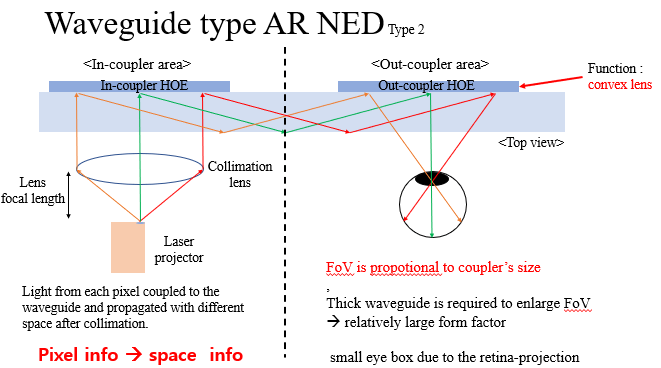
Another type of waveguide AR NED, which is also called maxwellian type NED, is just like the above figure. As I mentioned before, dot shape exit pupil of display is collimated and coupled by in-coupler. Unlike the type 1, this configuration, each pixel information is corresponding to the space information in the waveguide. Therefore, every point of out-coupler HOE has different light information, which means to see the full image, every light must focused to the eye. In this way, FoV can be enlarged but eyebox is shrunk to a spot. Multiplexed HOE can be used for the generation of multiple focal spots which enlarges the small eyebox of this configuration.
 AR/VR Study Bank_W.Han